Louisenlund Foundation - boarding school, all-day grammar school, IB World School
Louisenlund Foundation - boarding school, all-day grammar school, IB World School

The diversity of learning
HOW TRADITION AND CHANGE PLAY TOGETHER: A ROUTE THROUGH LOUISENLUND.
It's a cool, sunny morning in Schleswig-Holstein. In keeping with autumn, there is still some fog over the Große Breite, the Baltic Sea arm of the Schlei, between Schleswig and Eckernförde. Today is an exciting day for Leonie. She gets to watch Sid's lower incisors being trimmed. Her friend's teeth will grow all his life. Leonie is a junior pupil at the Louisenlund Foundation's grammar school and Sid is one of five fluffy alpacas that moved into Louisenlund in 2016. While Leonie stands by her animal friend Sid, we meet Dr Peter Rösner. The physicist has been the director of the Louisenlund Foundation since 2014, which was founded in 1949 by Friedrich Herzog zu Schleswig-Holstein and his friend Kurt Hahn according to the latter's reformist educational principles.

DR. RÖSNER, WHAT DOES THE FOUNDATION'S EDUCATIONAL PROGRAMME LOOK LIKE AND HOW MANY YOUNG PEOPLE ATTEND THE CAMPUS?
"As a foundation, we organise the framework conditions for the living and learning of currently around 490 German and international pupils. Our educational offerings include the primary school, the state-recognised all-day grammar school, the plus-MINT talent centre and the IB World School. More than 320 pupils live here on campus in the individual houses of our boarding school. Around 170 young people, especially primary school pupils and junior school students, come from the region and join the Louisenlund community every morning as day pupils."
WHAT IS SPECIAL ABOUT LOUISENLUND?
"In the administration, the teaching staff and with the house parents at the boarding school, we work every day to make Louisenlund one of the best places for young people to live and learn. When the young people leave us after their Abitur or IB Diploma, the international school leaving certificate in English, they should have developed their individual potential and tried out their many talents. Then they will have experienced appreciation here and lived in a strong international community with a culture of recognition that welcomes mistakes. I am always touched by how independent, motivated, open-minded and critical-thinking many of our students become. They can take responsibility for themselves and others. The location of our campus is also special, with Louisenlund Castle and the courtyard right on the banks of the Schlei, which is a great sailing area for the girls and boys. These are the best conditions for developing and unfolding close to nature."
WHAT CHALLENGES DO YOU SEE FOR THE FOUNDATION IN THE FUTURE?
"I am convinced that the way we think about how schools are organised needs to change significantly. Instead of trying to save the status quo for the future, we should accept the changing conditions under which we live on this planet as a challenge. Climate change, biodiversity, migration, digital transformation, mobility and demographics are examples of the scale of the changes. School must not become a simulation of a reality that no longer exists. How we deal with transience, uncertainty, complexity and ambiguity will have a particular impact on the future of young people. In Louisenlund, we abandoned the idea of homogeneity as the organisational basis for our schools three years ago after a broad discussion. Today, the heterogeneity of our school community is changing the way we think and is increasingly changing the processes with which we organise our schools and the collaborations in which we work. Existing structures of the previous teaching organisation, such as learning in class groups and year groups, are increasingly dissolving. We are systematically replacing them with other structure-building elements. In addition to subject-specific requirements and transparent performance records, in future we will tailor individual learning plans to each pupil and combine them with suitable content, times and rooms. In this way, we create a learning environment that is characterised by care, empathy, encouragement, respect and commitment."

WHAT ROLE DO THE TEACHING/LEARNING ROOMS PLAY IN THIS CONCEPT?
"The variety of possible learning paths in Louisenlund requires flexible learning situations that require spatial variability in our learning centres. The traditional classroom will soon no longer exist here. Both in the castle and in the courtyard, we find ourselves in a historically evolved environment that can only be developed in an educationally meaningful way to a limited extent. It was therefore clear to us that we wanted to create spaces in which individualised learning in all its facets could also function. As a first step, we opened a new primary school for more than 60 children in 2018, in which there are no longer any classrooms and learning is organised across year groups. In August 2020, the second step involved gutting the historic barn on the farm and equipping it with open learning spaces for more than 70 learners at junior level (years 5 to 8) and a work area for teachers that enables agile working and collaboration. The third step is currently under construction: our new learning and STEM research centre for the future 400 learners in the upper school and the IB World School."
Suddenly Leonie is standing next to us again. She has been instructed by Christian Helm, the head of the junior level, to accompany us to the learning barn. The third lesson is about to start. "What's wrong with Sid's teeth?" we want to know. "It's not too bad. The vet filed them down very carefully and then I was allowed to take him back out into the field". As we walk, we notice the ease and joy with which Leonie's classmates enter the learning barn. Unlike in many schools, we stand directly in front of an inviting cloakroom with space for jackets, shoes and backpacks. The children walk up two wooden steps on socks and lie or sit down on a cosily lit, cushioned object. "This is our LazyLab," explains Max, who, like Leonie, is in the Year 5 and 6 learning group.
"Here we rest or play, sometimes we do German together and read something. Shall I show you the magnifying glass?" The magnifying glass is a wall that can be written on from floor to ceiling, on which something can be discussed and explained in small groups. There are three magnifying glasses in the building. The walls are barely recognisable as a whiteboard surface. "The magnifying glass is even magnetic so that we can hang up paper and posters," explains Max.
Mr Helm approaches us with a laugh: "Yes, that's how it is here. The children see the building as their own place of learning. The distance between learning and relaxation has decreased significantly since we moved in. The entire area around the LazyLab can be used by the children, especially those who are accommodated here in the boarding school, in their free time in the evenings." Then it suddenly becomes quiet. Study time in the barn begins. All the pupils have independently taken the necessary items from their rucksacks to the learning area and found their places.
MR HELM, IS IT ALWAYS THIS QUIET HERE?
"Surprisingly, yes. We have introduced a whispering culture in consultation with the children. There are no traditional lessons in the barn. There are special input rooms in the area around the barn. The children come here during learning times to work on the content and tasks prepared for them by their colleagues in the individual subjects at their own pace. The subject teachers support the children in this and provide subject-specific impulses depending on their individual learning level. Levels 5 and 6 form a learning group across the year groups, as do levels 7 and 8."
HOW IS THE EQUIPMENT ADAPTED TO THIS?
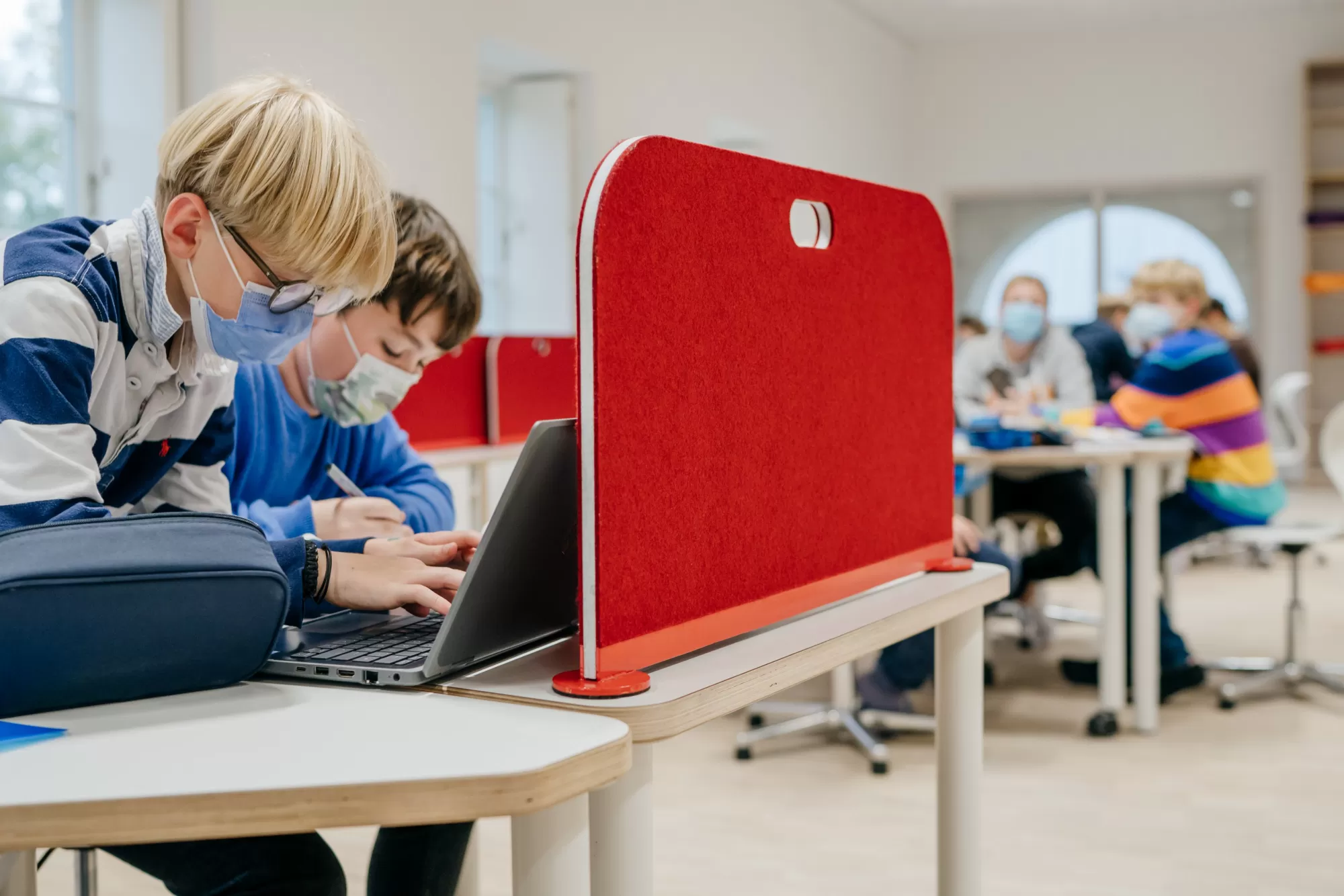
"We think flexibly. The furnishings fulfil today's needs, but also allow for future changes. We were looking for a harmonious mix of different functions. Tables in different sizes and shapes, from individual tables to large organic table landscapes, which we position in the room as required. All the tables can be customised by the learners with inserts and our Henkelmännern, which are red acoustic absorbers, to suit their individual needs. The large free-form tables look like swarms of butterflies when all the yellow acoustic absorbers are pushed onto the table tops. Are pushed onto the table tops. All tables are coordinated in terms of material and colour and are part of the FLEX range from Flötotto. Just like the PRO-Chair swivel chairs, which we deliberately use here without castors. We have our stadium between the learning spaces: upholstered seating with high backs that provides a place of retreat for up to eight children in the centre of the learning area."
WHAT EXACTLY DOES THIS AWAKENING IN LOUISENLUND LOOK LIKE?
"If you start this change process like we did, you need broad agreement and the support of all those involved. It's not just the type of learning that changes for the pupils, but also the role of the teachers and the type of collaboration as a whole. At Louisenlund, we want to think about skills-orientated teaching consistently from the point of view of the pupils' learning. This means that the learners know what they should have learnt by the end of the lesson. They should know the learning steps they will take and understand why it is important to deal with a particular topic. This is, of course, a very differentiated, continuously evolving process that is organised differently in primary school than in lower secondary school, which in turn differs from the approach in upper secondary school or the IB World School."

WHAT LEARNING MATERIALS CAN THE CHILDREN USE?
"Learners can access two personal organisation systems in this room. Firstly, there are four differently coloured Gratnells shelves for learning materials that each child has. These are located on the walls in the sideboards, accessible at all times and visually present. The drawers can be taken to the tables and slid into the rail system provided under the table top. We also have laptops for all children, which they can use to access their personal learning platform in the school cloud. This minimises the need to carry school materials back and forth."
WHAT IS THE CHALLENGE OF AN OPEN LEARNING SPACE?
"It's the different needs. Some want to concentrate on their work, others come to a standstill because they have a question, while others want to exchange ideas in small groups.
The demands on us teachers are more complex than in conventional lessons because we need to keep an eye on the individual child's learning status and learning steps. This is why it is important that we can leave the learning area for stimuli with individual children or small groups and have good opportunities for in-depth learning with the magnetic walls that can be written on - the magnifying glasses that you have already seen.
for in-depth learning. We can also use the roundabout, a glazed room with large sliding doors that can be seen from the learning area. A large round table can also be used for different learning situations in group or individual work." Then we suddenly find ourselves in the teachers' transparent work area, which can be seen through a large glass door. The room is characterised by a central table for meetings and work as well as coral red PRO-Chair meeting chairs. Here, too, the walls are labelled as information carriers and filled with notes. Agile working, agile working, short information paths and intensive professional cooperation are visible proof that the Louisenlund team also favours individual learning.